
Telemedicine in the Era of the novel Coronavirus
Author: Danielle Shelton, MD, DABFM, Family Medicine Physician, Re:Think Health Co-Founder
The Facts
COVID-19 has brought many strange things into existence – the phrase “social distancing” as a normal part of the national lexicon, drive through, well, everything, nightly Zoom chats (wine optional), and birthdays, weddings, graduations, or any monumental life event celebrated alone, sans family, friends, and hoopla.
It has also made healthcare, a so called “recession proof” industry suddenly, well, less so. Mandated weekly PTO, downsizing, layoffs, and even daily emails of revenue lost have all become part of the healthcare organization’s daily grind, along with prepping for an influx of critically sick patients.
There is not one realm of healthcare untouched by these strange time. Patients who usually swarm into waiting rooms with aches, pains, mild coughs are suddenly reevaluating their ailments while they hunker down with their families. On the flip side patients experiencing chest pain or stroke like symptoms sit paralyzed in their recliner, too terrified of the contracting COVID-19 as soon as walking through the doors of their local hospital. Routine follow ups, physical therapy appointments, surgeries, emergency rooms, and thus hospital volume has dropped precipitously creating large income gaps that were previously unimaginable.
Around mid March, when this pandemic developed teeth in the US, my office stopped seeing most patients in the office. There were starts and stops and billing questions (i.e. billing fears) popping up left and right. Especially has early organizations like the American Academy of Family Medicine started pushing for Telehealth services.
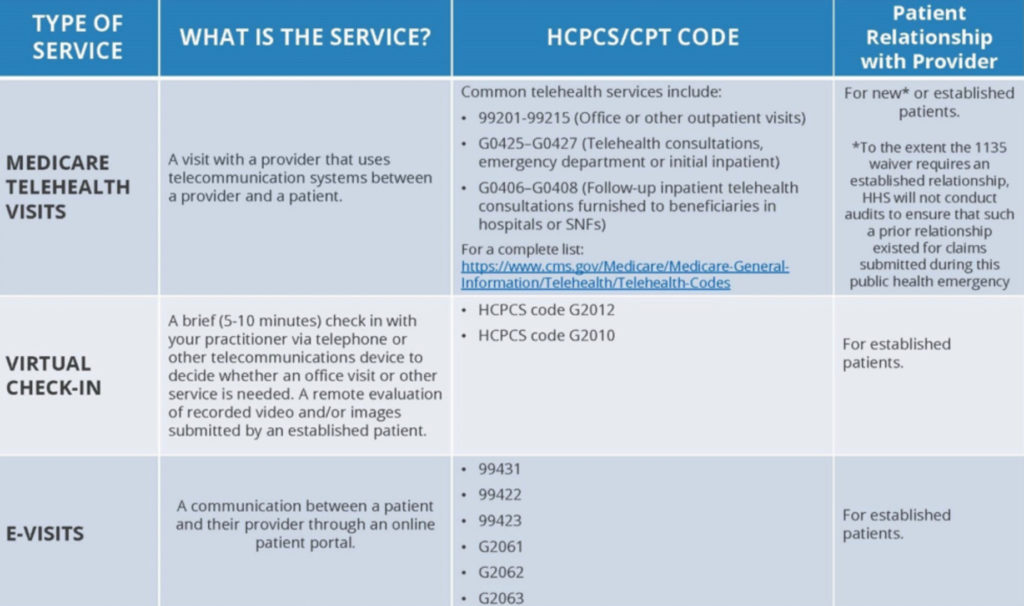
What counted as telemedicine? What services could be billed? What device did you have to have? What kind of connection?
Under the current administration’s leadership in order to limit the spread of community COVID-19, the Centers for Medicare & Medicaid Services (CMS) broadened access to Medicare telehealth services so that beneficiaries could receive a wider range of services from their doctors without having to travel to a healthcare facility. These policy changes build on the regulatory flexibilities granted under the President’s emergency declaration.
CMS expanded this benefit on a temporary and emergency basis under the 1135 waiver authority and Coronavirus Preparedness and Response Supplemental Appropriations Act. The benefits was part of the broader effort by CMS and the White House Task Force to ensure that all Americans – particularly those at high-risk of complications from the virus that causes the disease COVID-19, were aware of easy-to-use, accessible benefits that could help keep them healthy while also limiting community spread of the virus.
Several key organizations launched guidelines that were helpful, though confusing in the earlier implantation of Telehealth services.
Six Key Changes During COVID-19 Emergency (adapted from the American Medical Association)1
The Centers for Medicare & Medicaid Services (CMS) lifted Medicare restrictions on the use of telehealth services during the COVID-19 emergency. Key changes include:
- Effective March 6 and throughout the national public health emergency, Medicare will pay physicians for telehealth services at the same rate as in-person visits for all diagnoses, not just services related to COVID-19.
- Patients can receive telehealth services in all areas of the country and in all settings, including at their home.
- CMS will not enforce a requirement that patients have an established relationship with the physician providing telehealth.
- Physicians can reduce or waive cost-sharing for telehealth visits.
- Physicians licensed in one state can provide services to Medicare beneficiaries in another state. State licensure laws still apply.
- HHS Office for Civil Rights (OCR) offers flexibility for telehealth via popular video chat applications, such as FaceTime or Skype, during the pandemic.
The Practical Approach
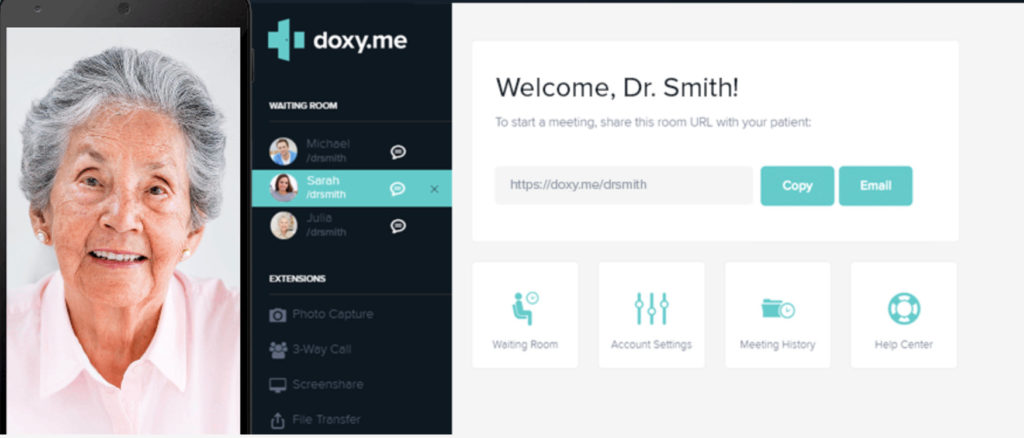
I helped implement the telemedicine program at my hospital. After reviewing a few platforms I landed on doxy.me as the platform of choice. This was chosen over a variety of others as it is HIPAA, GDPR, PHIPA/PIPEDA, and HITECH compliant, requires no apps or programs to download either for our institution or for our patients, is accessible from anywhere (desktop, tablet, or smartphone), and
F R E E.
As the free model is the most basic we utilized gmail (gmail.com) to create a free email account and then created a free phone number at text free (https://textfree.us). Our front office staff contacts the patients the day before their scheduled appointment and emails (via the gmail account) or texts (via text free) the link to our virtual waiting room. Most patients have been more than happy to conduct their office visit this way.
The caveats are multiple – it is difficult to conduct any kind of physical exam utilizing this modality (i.e. can you look at this rash conversations), it requires patience (dropped communications), it can be challenging for less tech savvy individuals to figure out, and it requires excellent WiFi and/or signal.
However, I have found that my practice volume has maintained itself utilizing this tool. I have also found it a great service to my patients as it allows us to continue their care unabated and to address any new concerns.
Based on the ease of use, patient endorsement, and physician ease of use, I am hard pressed to imagine a healthcare world that isn’t fundamentally changed by this widely available software.
Sources:
- The American Medical Association: https://edhub.ama-assn.org/steps-forward/module/2702689
- Centers for Medicare & Medicaid Services: https://edit.cms.gov/files/document/medicare-telehealth-frequently-asked-questions-faqs-31720.pdf
- American Academy of Family Medicine: https://www.aafp.org/patient-care/emergency/2019-coronavirus/telehealth.html
subscribe
to our mailing list
